Forbidden Message Categories for SMS and MMS in the US and Canada
Forbidden Message Categories for SMS and MMS in the US and Canada
The messaging use cases described below are strictly prohibited on SMS and MMS platforms in the United States and Canada. These guidelines apply to Short Code, Toll-Free, and Long Code messaging under the new A2P 10DLC system.
Forbidden Use Cases:
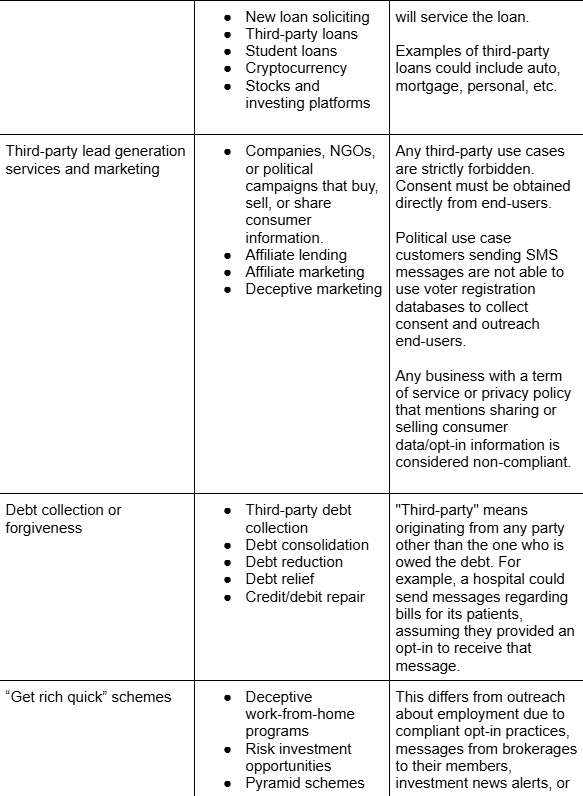
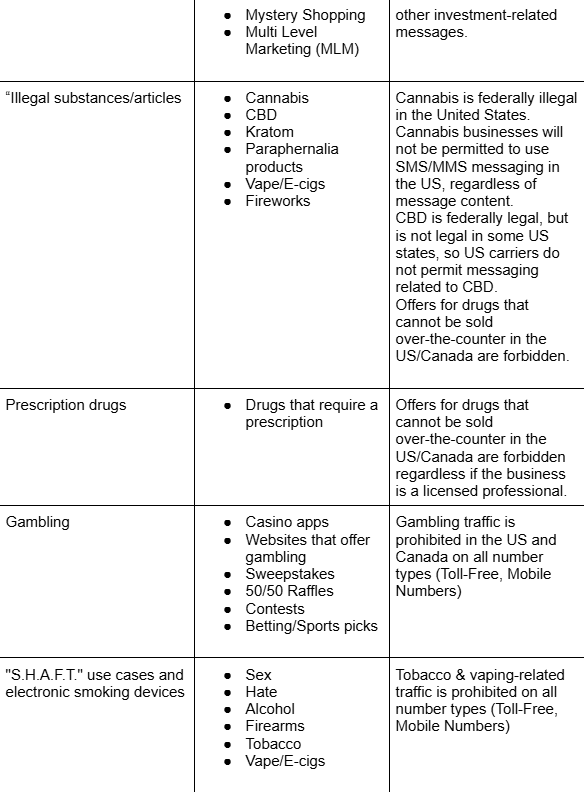
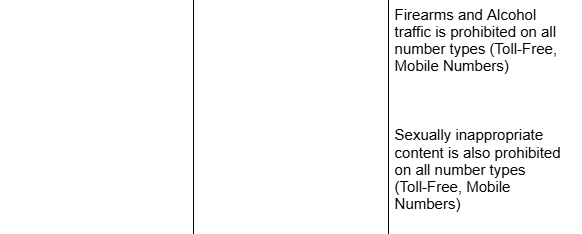
Certain types of messages are not allowed, and we take these restrictions seriously to maintain a safe and reliable messaging environment for all users. It is essential to refrain from engaging in the following activities listed in the table below. Please note that these forbidden use cases are not only related to the content of the message but the business type itself.
Additional Restrictions:
Even if your specific use case is not listed as prohibited, certain message content may still be subject to restrictions. For instance, the use of shared or free public URL shorteners is not permitted and will lead to filtering. Ensure that when using a shortened URL it is company-branded.
Caution:
Violating this policy will result in the suspension of SMS/MMS services for the sub-account.
Please note that Starting February 15, 2024, T-Mobile will implement new Sev-0 fines for A2P 10DLC non-compliance, targeting messages with prohibited content. If T-Mobile detects violations, they will issue a Sev-0 violation— the most severe type—resulting in an immediate block of the offending messages and a non-compliance fine. These fines, which range from $500 to $2,000 depending on the severity of the violation, apply to all commercial A2P messaging products, including SMS/MMS short codes, toll-free, and 10DLC numbers. will pass these fines on to users who violate the rules, and T-Mobile reserves the right to permanently suspend access to their network for repeated or severe infractions.

Frequently Asked Questions (FAQs)
Question: What happens if I violate the SMS/MMS messaging policy?
Answer: Violating the policy will result in the suspension of SMS/MMS services for your sub-account. It’s crucial to adhere to the guidelines to avoid service disruptions.
Question: Are there any fines for sending prohibited content over T-Mobile’s network?
Answer: Yes, starting February 15, 2024, T-Mobile will impose fines for non-compliance with A2P 10DLC messaging policies. Fines range from $500 to $2,000 depending on the severity of the violation, and offending messages will be blocked immediately.
Question: Can I send messages related to cannabis or CBD through SMS/MMS?
Answer: No, SMS/MMS messaging related to cannabis or CBD is prohibited in the U.S. and Canada. However, you can explore alternative marketing channels such as email or social media, provided you have appropriate age verification in place.
Question: What is a Sev-0 violation, and how does it affect my messaging capabilities?
Answer: A Sev-0 violation is the most severe type of consumer violation. If you commit a Sev-0 violation, your messages will be blocked, and you will be fined. Repeated violations may lead to the permanent suspension of your access to the T-Mobile network.
Question: Are there restrictions on using URL shorteners in SMS/MMS messages?
Answer: Yes, the use of shared or free public URL shorteners is not allowed. Only company-branded short URLs are permitted to avoid message filtering and ensure compliance with messaging policies.
Question: How often are compliance rules updated? Answer: Carriers frequently adjust and tighten messaging requirements. It’s important to periodically review updated guidelines or announcements to ensure ongoing compliance.
Question: What should I do if my use case is prohibited for SMS and MMS messaging? Answer: If your use case is prohibited for SMS and MMS messaging in the US, you can explore alternative marketing channels. For example, you might consider using LC Email. Cannabis or CBD-related messaging, for instance, can be carried out via email, Facebook, Instagram, and other platforms, as long as you have appropriate age verification in place and are targeting recipients in regions where the substance is legal.
Question: Can third-party financial or debt services send messages on A2P 10DLC? Answer: No. Messages must originate from the organization directly providing the service. Third-party loans, debt collection, or marketing are prohibited.
Question: My business is legal in my state; why is my content still being filtered? Answer: SMS/MMS compliance is governed by federal law and carrier-specific policies, not just state law. For example, while Cannabis or CBD may be legal in certain states, they are federally restricted or prohibited by carriers, making them non-compliant for SMS/MMS across the entire network.
Question: If I use emojis or creative spelling to avoid forbidden terms (e.g., using “C@nnabis”), will I still be fined? Answer: Yes. Carrier AI and manual audits are highly sophisticated. Attempting to bypass filters using creative spelling, emojis, or code words is considered “Deceptive Messaging.” This is often flagged as a Sev-0 violation, which triggers immediate fines and a permanent block of your brand.